I Choose the Potter's Hands

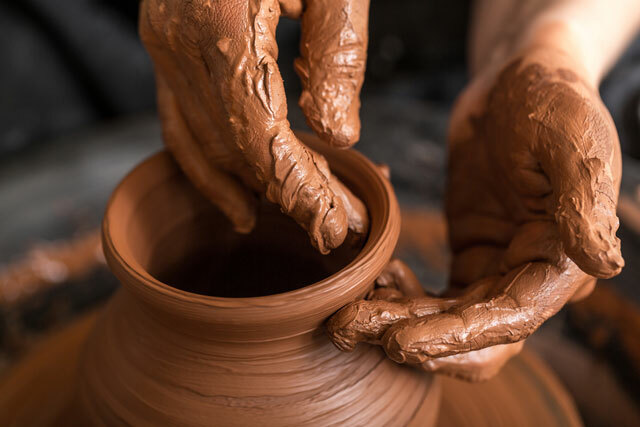
I Choose the Potter’s Hands
The word that came to Jeremiah from the Lord: 2 “Arise, and go down to the potter's house, and there I will let you hear my words.” 3 So I went down to the potter's house, and there he was working at his wheel. 4 And the vessel he was making of clay was spoiled in the potter's hand, and he reworked it into another vessel, as it seemed good to the potter to do (Jer. 18:1-4 ESV).
In the second semester of my sophomore year, I had a personal crisis. I was confusing my academic goals with the “freedom” of being a young college student. I had waded too deep into the party world and was in over my head. My grades were suffering. Then something dramatic happened. One night, I was doing my usual partying when I collapsed. I awakened to a dismal world of severe anxiety and darkness. It lasted for hours.
Over the next few weeks, I made a series of transformative life decisions that set me on a new path. While the details of this period of my life are better suited to a roomier platform, suffice it say that the most important life decision I made during this time was a full surrender to the Lord.
Shortly after my terrifying experience, I took my mountain bike up to the top of a trail. I accessed the trail behind my fraternity house, up through a peaceful woodland, to an opening with golden light and a twisted tree that had lived long enough to tell many stories. I sat under that tree and removed my backpack. In it was an apple, a sandwich, a Bible, and a book that someone had let me borrow. I opened my Bible and words that I had learned as a young child came alive. It’s as if I had always understood their meaning, but never intimately knew what they were saying to me. At some point I set my Bible down, stood up, and raise my hands to the heavens. I said something like this to God, “Lord, I am yours. I am sorry for my sins, stubbornness, and pride. Do with my life whatever you want. I am not longer my own. I want to follow you wherever you lead.”
I immediately experienced a deep and abiding peace. I had chosen the potter’s hands. My life would be much different from this moment.
The potter‑and‑clay motif in Scripture portrays God as the sovereign Creator who shapes, forms, corrects, and repurposes His people according to His will. Across passages like Jeremiah 18, Isaiah 64:8, Job 10, and Romans 9, the image emphasizes that humanity is like clay—dependent, malleable, and unable to define its own purpose apart from the Potter’s hands. There is a warning of judgment that describes the potter as having the right to destroy the lump of clay and start over. But there is hope. Jeremiah also records some good news. The Lord said that if the people would turn from evil, then He would move from a direction of judgment (18:8).
In Jeremiah’s vision, the potter reshapes a marred vessel, illustrating God’s authority to judge or restore a nation based on its response to Him. The prophet Isaiah uses the image to confess Israel’s dependence and plead for mercy, while Paul applies it to God’s freedom in directing salvation history. Together, these texts present a unified theme: God’s sovereignty is purposeful and just, human beings are formed and re‑formed by His design, and repentance keeps the clay responsive to the Potter’s shaping. The motif ultimately invites humility, trust, and hope in the God whose hands remain steady over His creation.
In Isaiah, the people humbly surrender to the LORD God with these words: “But now, O Lord, you are our Father; we are the clay, and you are our potter; we are all the work of your hand” (Is. 64:8).
This is really the only option for the serious believer. We can either insist on a self-centered worldview or we can humbly acknowledge God’s sovereignty over His creation, beginning with ourselves. The Scriptures are full of warnings as well as examples of how things go wrong when people ignore God’s clear instruction.
Phillip Yancy shares a personal story,
In high school I took pride in my ability to play chess. I joined the chess club, and during lunch hour I could be found sitting at a table with other nerds, poring over books with titles like Classic King Pawn Openings. I studied techniques, won most of my matches, and put the game aside for 20 years. Then I met a truly fine chess player who had been perfecting his skills long since high school, and I learned what it is like to play against a master. Although I had complete freedom to make any move I wished, none of my strategies mattered very much. His superior skill guaranteed that my purposes inevitably ended up serving his own.[1]
We aren’t just playing chess against a master player, we are living lives in a world created by an omniscient, benevolent, all-powerful God. This God designed us and the universe in a certain way. While we may not understand all of this design, especially in light of the suffering and evil that we see and experience, it makes sense if we acknowledge ourselves as clay in the hands of the Master Potter.
Keep in mind that the goal of any potter is to create useful pottery. The master potters are really good at it. Most potters also have in mind to create a vessel that is beautiful to behold. There is both a utilitarian as well as an aesthetic goal in the mind of the best potters. God chose this illustration as a teaching tool to both Jeremiah the prophet as well as the people of Israel.
In some ways, this has been the story of the Bible from Eden until the end. Humans want to be their own gods. We want to govern ourselves. Yet there is a better way. In simply agreeing with this analogy, we are positioning ourselves to fit in better with the ultimate plan that God has for us. We are being invited to voluntarily acknowledge the Potter in such a way that we get to share in the joy and design in our Creator’s mind.
God will accomplish His will one way or the other. The good news is that despite human freedom, the entire direction of the story in which we find ourselves is one that ends in restoration and on to a new beginning. Yancy continues,
God grants us freedom to rebel against His original design, but even as we do so we end up serving His eventual goal of restoration (Rom. 8:21; 2 Peter 3:13; Rev. 21:1). This transformed the way I view both good and bad things. Good things—such as health, talent, and money—I can present to God as offerings to serve His purposes. And bad things—disability, poverty, family dysfunction, failure—can be “redeemed” as the very instruments that drive me to God.
While we may resent such a powerful and determined God, if we understand that He is not a heavy-handed tyrant, but a loving and compassionate God whose goal is a world without sin and suffering, it should impact our perspective. He desires that we have a relationship with Him. Jesus Christ is the gateway to that relationship.
My story has not been perfect. Since that time of full surrender, I have had to remake that choice many times. I have had to acknowledge that His ways are higher than my ways. I have had to trust Him when my circumstances made no sense. I have had to walk through the valley of the shadow of death and remind myself that He is still my shepherd. But I am grateful to be in His hands. I am more suitable in His hands than my own for the things that really matter in this world. I trust my spirit and future life with His promises to live again after I leave this world. I want to be a part of the restoration process in this world now and look forward to a new heavens and new earth someday.
I choose the potter’s hands. Will you?
[1] Yancy, Phillip, “Chess Master” https://www.vecamelbourne.com.au/chess-master-philip-yancey, May 8, 2015 from Our Daily Bread